
Hierarchy & Me
A resource page for leaders to navigate power dynamics.
Power orientation is how someone views power and authority in the workplace.
You set up an open-door policy and some staff never visit you.
The project lead on your team is always silent when you ask the group for feedback.
Decisions stall because people wait for permission you thought you’d already given.
These are not faults with you or your staff.
These are signals of how power is working underneath the visible friction in your workplace. The good news is that there is a way to navigate these frictions and lessen your frustration. To begin, we need to understand ourselves before we can understand others.
How do you view power in an organization?
We can’t expect to get directions to our destination if we don’t know where we’re starting from. Sometimes holding up a mirror, examining what has shaped and influenced us will help us understand why we react certain ways, have certain expectations with our co-workers and how we understand other people’s behaviours.
We all view power and authority differently.
For me, I like a more flat-style, equal view of power - everyone’s voice matters and needs to be heard. This is because I largely grew up with strict hierarchical systems, both with military parents and my religious upbringing. These structures gave authority to very specific people and rarely was it me. I saw how many are left out of conversations, those who are punished when they challenge power or authority and the ways in which many are silenced due to strong hierarchical order.
Others may have grown in environments where power wasn’t necessarily about one person having sole authority, but about protocol, respect and relationship within community. Power is universal. How it is embodied, demonstrated and understood is cultural.
Three Power Orientations
There are three main ways power moves. Which is wild to me because I have only ever understood two.
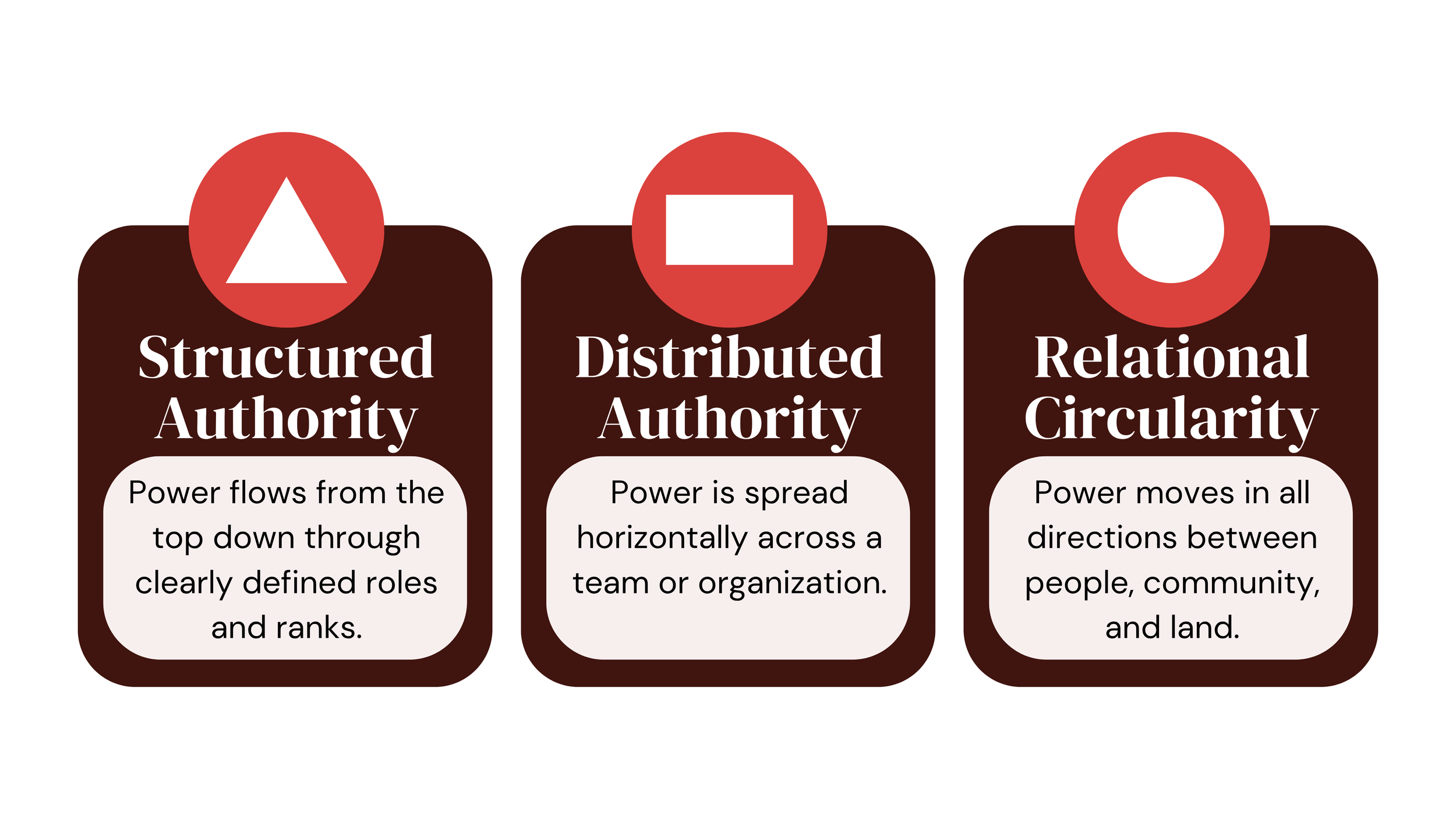
Isn’t that cool? None of these is wrong. All of these are present in every room you lead . . . and can show up also in you.
Let’s Dig Deeper
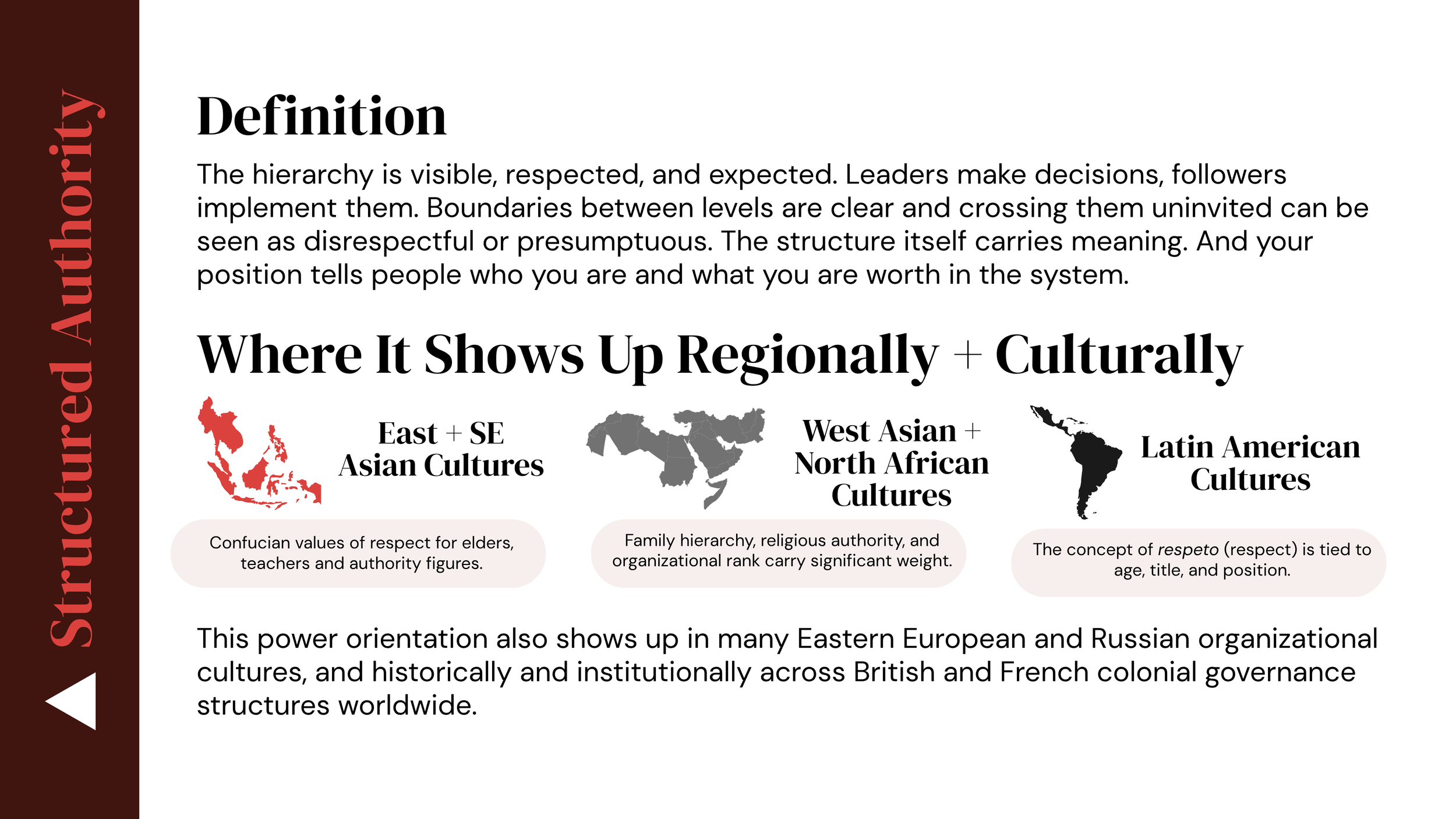
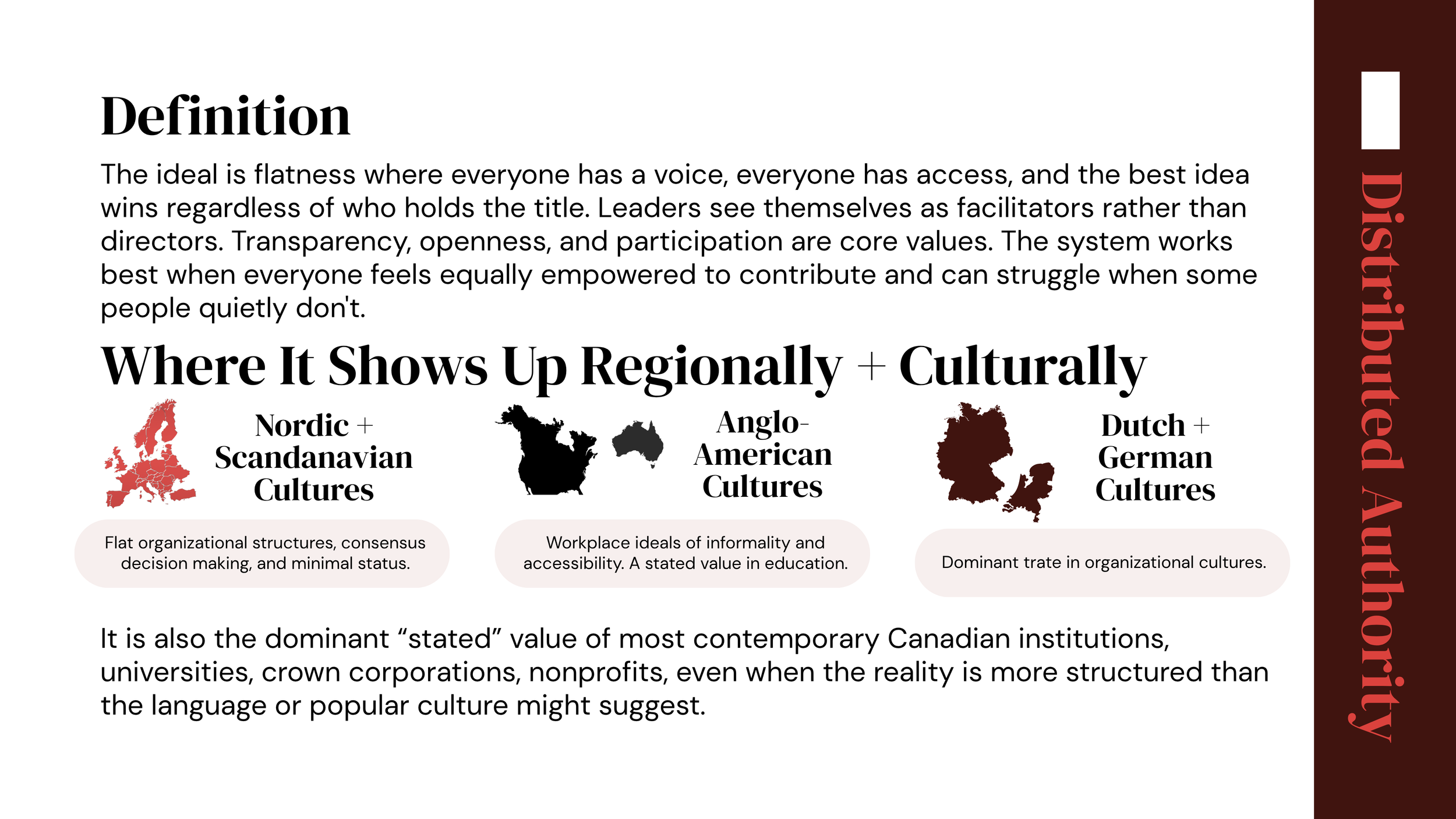
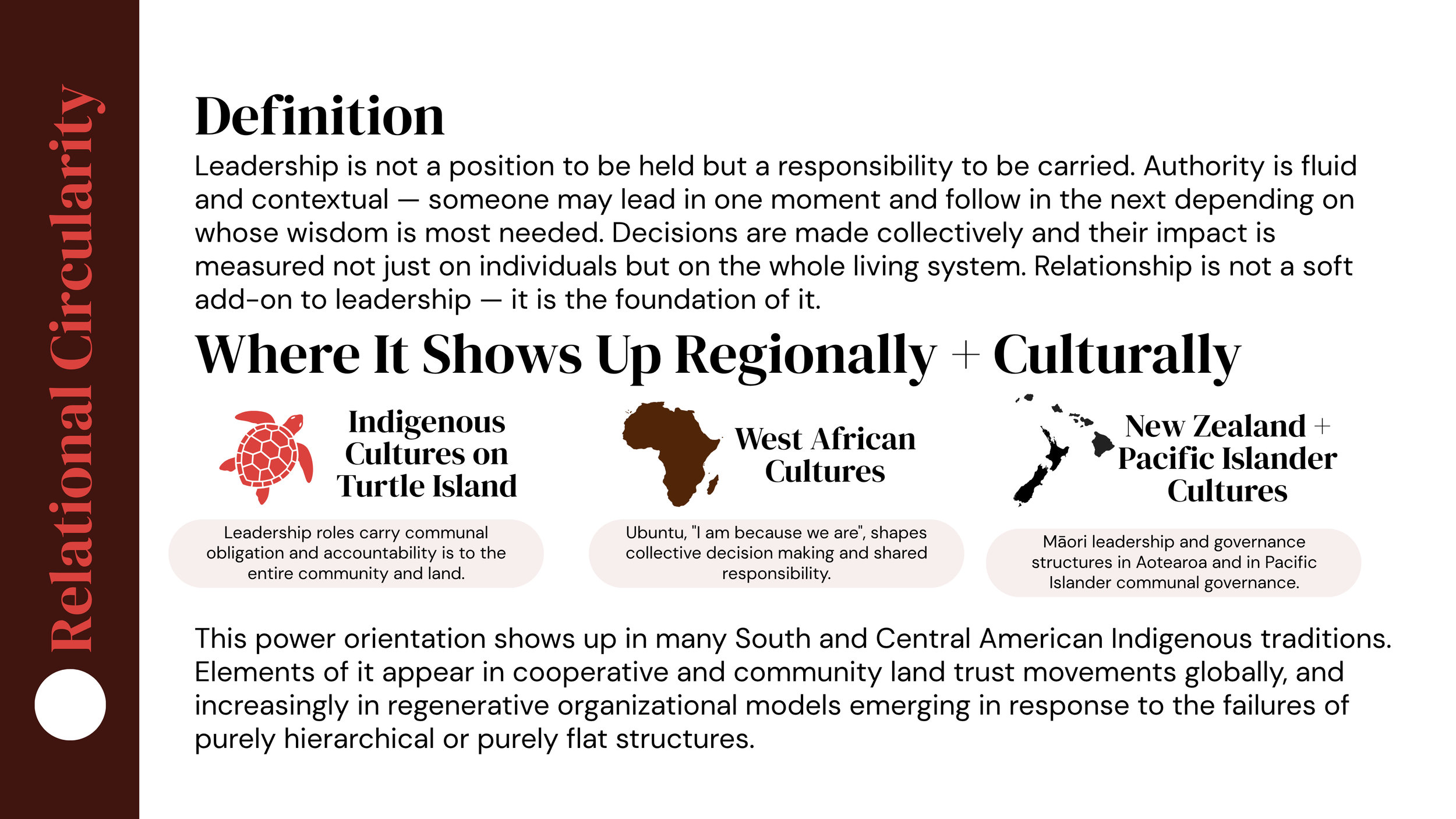
Even though these are cultural snapshots, there are elements of each power orientation that all of us might identify with as it relates to our position in our family, our workplace or even if we do work globally. And no one is static - power moves, just like people. So while I may have grown up with stronger structured authority, I tend to live my life as an adult with distributed authority.
How It Might Show Up At Work
-
Ahmed is a senior manager at a large corporation. His team never emails him directly — they route requests through his executive assistant. In meetings he speaks last, and when he does the conversation closes. His team would never challenge him publicly — disagreement, if it happens at all, happens privately and carefully. New employees who try to be casual with Ahmed are quietly coached by colleagues. This is not dysfunction. This is a system operating exactly as it was designed to — with clarity, order, and defined accountability at every level.
-
Sarah leads a team of twelve at a Canadian university. She sits in an open plan office with her team, signs her emails with just her first name, and opens every meeting with a check in question. She genuinely wants everyone to speak up and contribute equally. Her door is always open — literally.
The challenge is that three members of her team come from cultures where speaking before a senior person is considered disrespectful, two are introverts who process slowly and are consistently talked over, and one is a racialized staff member who has learned that speaking up carries different risks for her than it does for her colleagues. Sarah's distributed model works beautifully for people who already feel safe and equal. For everyone else it is accidentally exclusive. -
A First Nations band council is making a decision about land use. The process does not begin with a vote or a memo from the Chief. It begins with a gathering where elders speak first,. This isn’t because they hold the highest title but because their accumulated wisdom is the most valuable resource in the room. Younger members listen before they speak. The decision is not made until there is broad consensus. This is not because unanimity is required by rule but because a decision that fractures the community serves no one. The land itself is considered an interest holder.
The question asked is not "what is most efficient" but "what will we be proud to have decided seven generations from now." Leadership in this room is not a position. It is a practice.
Remember: People are Diverse.
A person born in Japan but raised in Canada, may have elements of two power orientations. Even in our own Canadian context, our attempts to treat everyone with equity can actually exclude and alienate because we ignored protocol, process or a cultural order. There are many factors that can influence how we see those in authority or how we perceive power in a workplace.
These are not judgements but signals for us to know how to communicate, engage and be the inclusive leaders we want to be.
So how do I do it, Andrea?
How do I avoid the friction?
1. Accept the fact that there will always be friction.
We are people. We all bring various experiences, upbringings, values and traditions into the workplace. Friction will happen. How we respond to that friction and even more so, how we prepare for it, will make all the difference. But we cannot avoid it. And we cannot be afraid of it.
2. Understand how YOU see power and authority.
Take the quiz above. Take it twice a year. See if you’ve changed. Think about how you were raised, what respect looks like to you or how you perceive your own power and authority. We often walk into the office with assumptions, biases and impulses we’ve rarely have had to examine. By looking inward, we will be able to understand what is outward.
3. Honour the ways in which others see and embody power and authority.
Especially as leaders, we have the positions of privilege to make changes or adjustments in our approach to how we run meetings, how we expect feedback from staff, how we communicate and how we lead our team. This is what inclusive, relational leadership looks like - where differences aren’t a perceived as a threat but postured as a gift.
Tools for you
Avoid sifting through thousands of Google search links.
The sources below are credible and proven to help leaders navigate the friction and become culturally intelligent. They’re free and they’re for you to use in your workplace, in your team meetings and in your own personal life.
Canadian Salad Podcast
Join me and my friend Hostion, co-hosts of the podcast Canadian Salad, for a two-part series where we define power structures and how our own cultures influenced our view of others who were different than us. Where Hostion and I find friction in our perspectives, we also discover a universal understanding of what healthy leadership and societies can look like. Take a listen!
Canadian Salad can be heard across all major platforms. All of the sources we cite in the episode can be found on our website here. Subscribe as we drop a new episode related to culture every Tuesday!
The Educators
Power dynamics, hierarchies, social structures and cultural protocols have been studied for a long time. There are many great resources you can review. Below are a list of online links, book recommendations and other academic materials in case you really want to nerd out on it.
-
For many years, sociologist Geert Hofstede studied how various countries and their cultures navigated universal workplaces. He found six cultural pillars which were formed from thousands of surveys conducted across global corporations.
Interested in how Canada sees power vs. another country? Check out the country comparison tool here.
-
Erin Meyers, author of The Culture Map, found the six dimensions of culture to be a bit too narrow. She expands to eight cultural components on how global societies and cultures communicate, structure their societies and perceive the rest of the world.
You can explore her materials here on her website.
-
Edward T. Hall explores the non-verbal components of how cultures and societies communicate. He explores how our view of time and space cause us to communicate differently and thus be more misunderstood.
The Silent Language, one of this books, is an excellent read if you want to explore the silent ways we and others communicate.
-
Much of what we have explored on this page is about having a type of intelligence to understand differences and cultural perceptions. While there are certificates and training for cultural intelligence (CQ), I believe we are all capable of developing a stronger cultural sense in our own way. You don’t need a certificate to be more human.
If you are new to this word and the concept of cultural intelligence or CQ, a great paper to read from the Journal of Intelligence is here.
That was a lot!
I know. Your brain probably hurts after reading all this juicy stuff about power and culture. Before you leave:
1. Take this information with you!
I’ve created a downloadable, free, printable PDF you can file away in your resource library or share with a colleague.
2. An invitation to explore more!
Bring this into your team — I run half-day workshops on power distance and relational leadership. Together we can make the friction less painful. Let's talk.