
Cultural Neutrality: The Jumbo Shrimp of Leadership
Why "neutral" project management was never actually neutral
There he was. He stood just a few steps in front of me. A man known in the professional project management world, who has developed his own PMI resources, performed keynotes and even contributed to an edition of the PMBOK Guide. He had travelled the world representing his project management leadership, and as a man of colour who had moved through these spaces his entire life, it was clear to me that he understood how the systems were built, shaped, and upheld.
My question was burning at the tip of my tongue, compelling me to wait in eager anticipation as he responded to another eager professional seeking to glean wisdom.
It was my turn now.
Palms sweaty and my question jumping up and down with excitement, I asked it: “PMI has global accreditation and recognition. It has become the global standard for project management. Why, then, are global cultures, dynamics, ways of communicating, perceptions of risk and methods of hierarchy - why is culture missing in these methodologies we learn? Why is it barely referenced in the PMBOK and never in these conference conversations? Why?”
Phew. I did it. I was ready for his answer, anticipating that his perspective would help me understand why the gaps remained gaps after all these years.
He paused. Smiled.
He looked at me and said, “I have an answer you may not like.”
May not like? Why? My mind began to race with assumptions.
He continued. “PMI was built for and delivered with the intention and standard of cultural neutrality. That anyone in any country could use the methodology, without the ‘barrier’ of culture. That’s why.”
My mouth dropped. Cultural neutrality.
He could tell I was shocked by his answer. Empathetic to my reaction, he continued, “I know. I get it. And there are various arguments that go both ways. But that is why.”
We continued to chat. I thanked him for his answer.
Cultural neutrality.
The Briefcase Belief — What Is Believed To Be True But Left Unexamined
You might be thinking, yeah, Andrea. What’s wrong with that? That makes sense to me. In fact, it makes it more accessible for everyone.
Initially, when left unexamined, it might be easy to agree. Trust the information you are given as it presents itself as the standard to strive for. A neutral methodology is a fair methodology. It seems safe
However, when pried open and examined, this claim of neutrality doesn’t hold up.
The Friction Moment — When My Understanding Collided With Others
Have you ever heard of an ‘oxymoron’? I’m not a fan of the word — more than half of it is an insult on its own. But it’s when two words, used side by side, contradict each other or connote opposing meanings. Take “jumbo shrimp”. ‘Jumbo’ means large, huge, a very big size. ‘Shrimp’ means small and petite. “Deafening silence.” “Bittersweet.” We use these in our English language, and they often convey a truth we’re expressing through the contradiction of their meaning.
To me, ‘cultural neutrality’ is one of those oxymorons. Why is that, Andrea?
Let’s break it down.
Culture embodies the traditions, values, beliefs, languages, music, food, family systems, habits and ways of thinking of a person. Culturally, I value my independence, and culturally I see very little difference between a boss and their employee. Culture is how I see myself, how I see others around me and how I see myself with others around me. It’s how I communicate, how I listen, how I dress and what I cook.
Neutrality, as Webster’s Dictionary defines it, is “the state or quality of not favouring or supporting a side. It avoids alignment and can often look like and be embodied through fairness or equality without bias or interest.”
Let’s put these two together. Cultural neutrality.
On the surface, it may seem like a polite and fair way to approach project management. No one’s culture is favoured, centred or aligned. Or is it?
PMI was constructed and developed soon after major legal victories of the Civil Rights movement[1], a time of great cultural change in the United States — a country that, for many decades, had continued to deny Black and Afro-Caribbean descendant peoples the right to vote, the right to an education, and positions of power within judicial, social and economic organizations. Founded by five people in Atlanta, Georgia, PMI’s foundational assumptions were forged on the cusp of racially exclusionary institutions during a very new period from active, legally sanctioned segregation. Please understand, I am not making the claim that PMI was inherently racist. But the context of any formation is important to understanding how ideas, models and methods are formed, with culture being a foundational influence. I say this not to tear PMI down, but because I believe in what PMI can become. Naming a blind spot isn't the same as rejecting the whole body of work.
As with any modern organization, model or even philosophy, the project management framework changed and adapted to survive social, economic and global change. International leaders pride themselves on the claim that many leadership frameworks are foundationally neutral, so that other countries and cultures can adapt to them.
But my biggest question is: PMI methodologies are culturally neutral for who?
If we’re willing to step back and take a critical look at the structure, format, philosophy and implementation of the project management process, that question of for who might surprise you.
One big example: Maslow’s Hierarchy of Needs.
Leadership Misinterpretation — The Misread That Deepened The Friction
I remember learning about Maslow in my master’s certificate course in project management, alongside that phone-book-sized study guide I poured into for my PM certification exam. Maslow’s Hierarchy of Needs was taught as a motivational theory for how to enable team cohesion and project success.
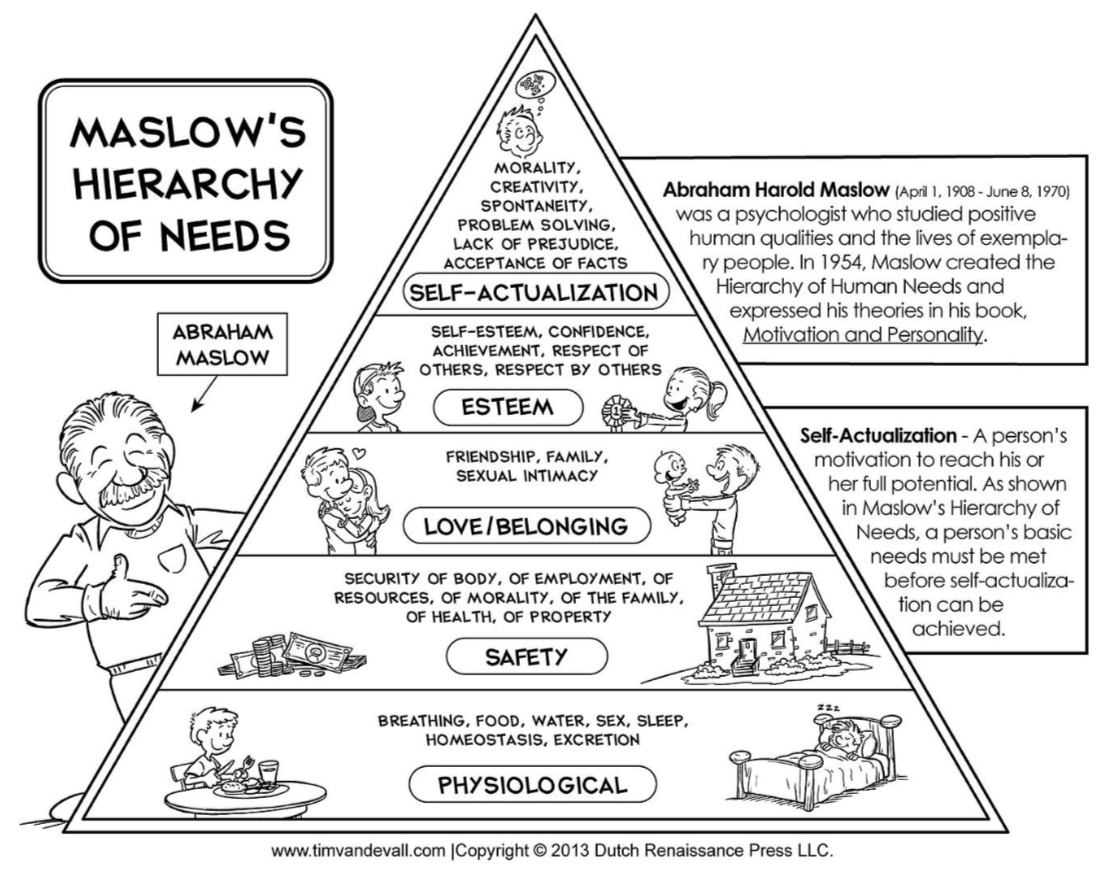
In his hierarchy, often diagrammed as a triangle, the base shows physiological and safety needs translating into a team’s basic working conditions: fair compensation, job security, reasonable workloads and psychological safety. Without these, according to his theory, no amount of project process, sprint planning or interest holder engagement will produce a high-performing team. Why? Unmet foundational needs drive disengagement, turnover and resistance to change. Translated into the project management world: meeting core needs of people is the first step in creating safety leading to belonging and ultimately, productivity.
The upper tiers like belonging, esteem and self-actualization, are where project managers are encouraged to move from managing tasks to leading people. This is a foundational piece of becoming a positive leader. On paper, Maslow’s model can be a useful diagnostic lens. It’s true that a team doesn’t fall apart because of a lack of process, but because of a lack of safety and belonging. Without meeting those needs, sustained performance can’t happen.
I agree. But I also disagree. Here’s why.
Before his motivational theory became a landmark framework in project management, Maslow had a different theory: that social hierarchies are maintained by the dominance of some people over others. He saw it in his own community, so he decided to explore other communities to see if his idea held true.
At 30 years old, Maslow arrived at Siksika First Nation, today known as colonial Southern Alberta, Canada. For six weeks, he lived alongside and observed the Blackfoot people — their way of life, who the dominant people were, and how social hierarchy was created. Spoiler alert: he found the opposite.
“He did not see the quest for dominance in Blackfoot society. Instead, he discovered astounding levels of cooperation, minimal inequality, restorative justice, full bellies, and high levels of life satisfaction.” He estimated that 80–90% of the Blackfoot had a quality of self-esteem found in only 5–10% of his own population. [2]
His theory that social hierarchy is maintained by the dominance of some people over others fell flat. Children were elevated as equals with their parents. The wealthy didn’t hoard their riches but often gave them away to the community. Wealth, in the Blackfoot culture, wasn’t measured by how much you had, but by how much you gave.
According to scholars, “Maslow saw a place where what he would later call self-actualization was the norm.” The closest word within the Siksika language to Maslow’s theory was niita’pitapi, meaning “someone who is completely developed, or who has arrived.”
While Maslow arrived on Siksika Territory with one theory in mind, another ideal emerged. Self-actualization was not something to be earned, but something the Blackfoot saw as innate.
Where self-actualization was at the top for Maslow, it was the foundational piece for the Blackfoot People. For them, regarding people as inherently wise made trust the default and belonging non-negotiable. “For many First Nations … self-actualization is not achieved; it is drawn out of an inherently sacred being who is imbued with a spark of divinity.”
Here’s an analogy. In Western culture, we earn degrees. We pay tuition, attend classes and become the “master” of our chosen subject. In Blackfoot culture, “it’s like you’re credentialed at the start. You’re treated with dignity for that reason, but you spend your life living up to it.”
And you’re not doing it alone.
This is the biggest piece that, I believe, Maslow left out — and we’ll get to why in a second.
What the Blackfoot showed him was that the work of meeting a person’s basic needs, including safety, wasn’t the responsibility of one person or up to one’s own self, but a result of an inherited identity found in the collective work of the community. This is called community actualization.
Community actualization is deeply engrained in many First Nations cultures across Canada. It’s embodied by caring for the people around you — not because you’re obligated to, but because that’s inherently what you do and how you see others. You are not bound by proving yourself; you’re bound by others who consistently support you, creating cultures of generosity, trust and cooperation.
Where Maslow’s hierarchy of needs is drawn as a triangle, the Siksika and other First Nations might diagram a person’s needs as a circle: no hierarchy, just a connected space where everything is interdependent. Human needs are integrated without a necessary order. When a person is deeply connected to and embraced by their community, that is where a person’s needs are met.
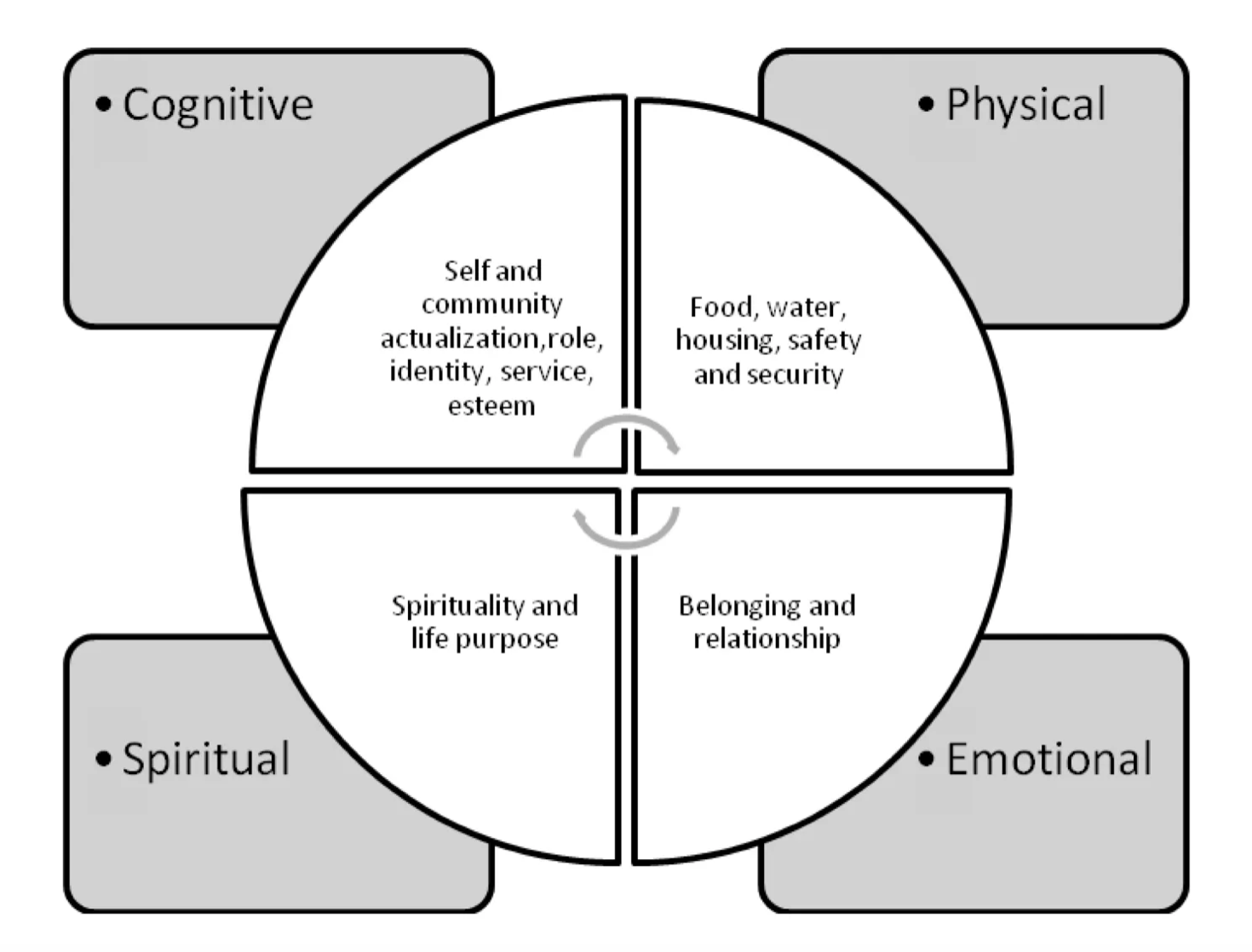
University of Alberta Professor Cindy Blackstock on a circular model of self-actualization found within First Nation communities, The Medium
Conflict still happens, but because there’s community acceptance by default, conflict allows us to pursue cooperation, practice forgiveness and share resources, making our teams and ourselves more content and cohesive.
Maslow’s theory fell flat because the ability to lead well is already found within — not something to strive for. And by his own admission, Maslow knew this. In an unpublished essay from 1966, about 23 years after his paper on the Hierarchy of Needs, he wrote Critique of Self-Actualization Theory. He stated, “[S]elf-actualization is not enough. Personal salvation and what is good for the person alone cannot really be understood in isolation. The good of other people must be invoked as well as the good for oneself. It is quite clear that a purely inter-psychic, individualist psychology, without reference to other people and social conditions, is not adequate.”
So what happened? Why don’t we see the Blackfoot model of needs or leadership embedded in our project management models or written in our textbooks?
The answer is mainly cultural. Maslow was living at a time when Indigenous peoples in Canada were deemed less than human under the Indian Act[3]. Their practices, traditions and ways of life were dehumanized and hated. University of Alberta professor Cathy Blackstock theorizes that Maslow may have worried his findings would discredit his own theories[4]. He knew how positively the Siksika would appear with those in power. To demonstrate anything contrary to mainstream cultural thought would be rejected. Maslow knew this, and he chose not to write about the paradoxes he’d originally found nor give credit to the Blackfoot Nation for the wisdom, philosophy or ideals surrounding self-actualization.
Indigenous worldviews challenge our status quo — and challenge what has been comfortable for those in power.[5]
Maslow’s hierarchy of needs was influenced by the Blackfoot people – their culture, traditions, ways of life and being. But Maslow chose what we might call “cultural neutrality”. The legacy of his message was quieted by his culture that wanted to dominate and control.
The Hidden Cost — The Cost of False Neutrality
Maslow’s Hierarchy of Needs is a part of Western culture. It’s not universal, and it’s not neutral. To claim such is to ignore the biggest component that shapes any type of process or organizational structure – culture. Culture is embedded in EVERYTHING. In my opinion, we are fooling ourselves if we believe that anything we do is culturally neutral.
We are all connected. Our cultures not only shape other cultures, but in some parts of the world, other cultures keep our culture alive. Culture is not static, nor is it ever fixed. Like us, it evolves, changes and adapts.
Maslow’s theory is not the only Western cultural practice embedded in project management frameworks. Many other processes and protocols are also deeply Western. Here are a few:
| Framework Element | Western-Centric "Neutral" Version | Globalized / Relational Alternative |
|---|---|---|
| Unit of accountability | Individual ownership (RACI, personal KPIs, "who owns this?") | Shared or family/team-based responsibility; success measured collectively |
| Goal-setting | SMART goals — explicit, personally owned, measurable | Relationally negotiated goals; direction agreed upon, specifics emerge through consensus |
| Self-actualization (Maslow) | Individual peak achievement sits at the top of the pyramid | Belonging, harmony, and communal esteem are the aim, not a stage to move past |
| Communication style | Low-context: explicit, written, "if it's not documented, it didn't happen" | High-context: meaning carried by relationship, history, and shared understanding |
| Team structure (Agile/Scrum) | Self-organizing teams, flat power, junior voices challenge leadership directly | Deference to seniority/role; input given through appropriate channels, often indirectly |
| Risk management | Risk registers, change control boards, rigid stage-gates | Comfort with ambiguity; adaptive improvisation trusted over process |
| Rule application | Universalist — the same rule applies to everyone, regardless of relationship | Particularist — rules bend based on relationship, context, and trust |
| Time orientation | Monochronic — linear, sequential, Gantt charts, hard deadlines | Polychronic — overlapping activities, relationships take priority over the clock |
| Status and authority | Achievement-based — earned through individual competency and results | Ascription-based — granted through age, seniority, family, or role |
| Change management | Linear, leader-driven cascade (Kotter, ADKAR) — announce, then adopt | Consensus-built first (e.g. nemawashi, ubuntu-based decision-making) — buy-in precedes the announcement |
| Feedback culture | Direct, individual critique ("radical candor"), even upward | Face-preserving, indirect, relationship-protecting feedback |
| Trust mechanism | Built through explicit process and documentation | Built through relationship, context, and shared history |
So what do we do with this?
Executive Insight — Practical Applications And Tools For Leaders
Stop Claiming Cultural Neutrality
We must stop claiming that our project management processes are culturally neutral. Historically, the founding of many of our organizational practices are led by, created by and upheld by Western influence and sometimes dominance. That isn’t neutrality. That is Western culture.
By claiming ‘culturally neutral’ practices, we’ve aligned ourselves with also being ‘colour blind’[7], making differences comfortable for the majority in power. Maslow’s time surely did and sadly, so do we.
Culture shapes a person’s approach to conflict, to risk, to communication and to leadership. This, in turn, influences how a team functions, how projects get completed and how success is measured. I’ve seen it too many times: conflict happens, misunderstanding sets in, leadership changes, and the team makes a mass exodus. The project is delayed, and sometimes it fails outright. We have all sorts of leadership tricks and tips; about 57,000+ books have been written to equip and define leadership.
We’re all searching for the how of effective leadership, when we’ve largely ignored the cultures we embody and are surrounded by. By committing to culturally neutral approaches, we ignore and disregard culture in our teams, in our projects and in ourselves. This makes our work harder, our mistakes more expensive and our project launches riskier.
Celebrate Culture As It Actually Shows Up
We must seize the opportunity to embrace culture, to celebrate it in others and in ourselves. I remember a phone call with my friend who immigrated from Jamaica. She’s a senior project manager here in Canada with ample international experience. I asked her how projects are initiated, assuming the team in Jamaica would sit down with a team charter, run some icebreaker games and sign a team commitment.
Nope. Not in her experience.
To initiate a project, you have a party. Yes, a party — a celebration. People from the community and the team are all invited to share a meal, dance and get to know each other. This immediately creates trust, builds rapport and creates the belonging a project team needs. And Jamaica isn’t the only one.
| Country / Region | Documented Practice | Western "Inefficiency" Label | What It's Actually Doing |
|---|---|---|---|
| Kenya / East Africa | Extensive personal conversation and shared meals before business dealings begin, sometimes over weeks; inquiring about family before any business discussion | "Slow to get started," "won't get to the point," wasted meeting time | Building the trust infrastructure that substitutes for (and often outperforms) written contract enforcement |
| China | Establishing personal connection before contract discussion; evaluating the relationship, not just the commercial offer (guanxi) | "Unfocused," "mixing personal and professional," slows deal velocity | Constructing an informal enforcement mechanism that reduces uncertainty around contract enforcement where legal recourse is weaker or slower |
| Middle East / Arab Countries | Contracts treated as memoranda rather than binding obligations; disputes resolved through personal discussion, not clause-citing (wasta) | "Doesn't honor agreements," "unreliable documentation," legally risky | Reputation and honor function as the actual enforcement layer — breaking a verbal commitment is considered dishonorable and reputation-destroying, arguably a stronger deterrent than a court filing |
| Japan | Consulting up to 80 stakeholders informally before a formal proposal is ever presented (nemawashi / ringi) | "Painfully slow," "can't make a decision," excessive process for simple approvals | Front-loads risk discovery so implementation, once approved, proceeds with minimal resistance or rework — total cycle time isn't necessarily longer, it's just moved earlier |
| Southern/Central/East Africa (Ubuntu-influenced) | Decisions reached by unanimity in "wisdom circles" rather than majority vote or top-down authority, without formal debate | "No clear decision-maker," "consensus paralysis," unclear accountability | Distributes risk and ownership across the group so implementation has full communal backing rather than resting on one accountable individual |
| Latin America / Brazil | Significant time spent on informal rapport — meals, conversation — before formalizing terms (personalismo, confianza) | "Not businesslike," "too social," slows the sales cycle | Trust is placed in the person, not the institution — confianza means being known and vouched for outweighs credentials or formal accomplishments, which lowers monitoring costs later |
| Kenya (communication style) | Indirect communication; direct criticism considered disrespectful; responses may reflect what others want to hear rather than a literal answer | "Not transparent," "can't get a straight answer," poor status reporting | Preserves the relationship and the other party's standing — status updates optimize for continued collaboration over immediate clarity |
| Latin America / Spain | Diplomatic, indirect refusals; harmony prioritized over blunt disagreement | "Won't say no," "avoids hard conversations," unclear risk signaling | Disagreement is expressed through tone, timing, and context rather than explicit statement — reading it requires relational fluency, not a status field in a Gantt chart |
Become A Community Steward
And finally, my hope is that the title of project manager can flourish into a new title for all of us: community steward.
In our Western world, we have this notion that our own individual hard work and our own strong ethics make for a successful leader. We pride ourselves on our accomplishments, parading our own sufficiency for everything we need. That sounds nice. But in Canada, more than 1 in 10 people aged 15+ struggle with loneliness[16]. We felt the pain of isolation during COVID, cut off from community, from friends and from family. Social development for young children has been affected too. Research shows higher levels of stress and less ease with social interaction among peers, and the impact may be more severe than we realize[17]. Loneliness leads to depression, anxiety and a host of other mental health tolls.
A title of ‘community steward’ begins with community. It establishes the reality that we are with others, not above them or in front of them, but with them.
We are held by the faith others put in us — to trust us, to rely on the gifts and abilities we bring, and to recognize there may be times we need help from the communities we find ourselves leading. We are integrated parts, with functional roles that, together, make us complete.
There’s not a creature or even a particle in the universe that’s self-sufficient. We’re all dependent on everybody else.” Who sewed the clothes you’re wearing right now? How many materials from how many different parts of the world are inside the device you’re reading this on? How many hands touched the food you ate for lunch on its way to your table? How many living beings participated in the creation of your home, your education and your emotional state? Even if you purchased these goods with money you earned, you’re relying on a community to care for you. Our lives are inextricably tied up with one another. Indigenous communities offer us an example of what’s possible when we embrace this reality.[18]
As stewards of this community we lead, this project team, we’re compelled to care for, nurture and protect the belonging, the intelligence, the gifts and the cultures that exist within it. By being a steward we lead with a sense of responsibility, care, a custodian of people, place and culture. [19] The calling is more than managing the project and delivering outcomes.
To be a community steward compels us to understand that the health and wellbeing of the group are part of the work itself. We don’t simply manage people toward a project outcome. We nurture the conditions that allow people, relationships, knowledge, and culture to flourish.
Stewardship asks us to consider not only what our team accomplishes today, but what we leave behind for those who come after us.
Being a community steward can look like:
Respecting the people and the collective. Care for the people doing the work. Pay attention to the health, wellbeing, belonging, relationships, and capacity of the group. People aren’t resources to be managed. They’re members of a living community whose knowledge, gifts, identities, and contributions matter.
Honouring continuity and legacy. Recognize the teams and communities that came before us and the knowledge, relationships, and work they entrusted to us. Consider the impact of our decisions on the teams and people who will come after us. Stewardship means leaving the community stronger, healthier, and more connected than we found it.
Being accountable to place. Our work doesn’t happen in isolation from geography, land, environment, and community. Regional and environmental differences shape how people gather, relate, work, and belong. Place matters. We must understand the relationship between our work, the places where we live and gather, and the communities connected to those places.
Protecting belonging and culture. Stewardship means actively creating conditions where people can bring their knowledge, identities, cultures, perspectives, and ways of being without being asked to conform to a single dominant way of working. Community health depends on the ability of people to belong without surrendering themselves.
Taking responsibility and being accountable. Stewardship means being willing to answer for the conditions we create and the decisions we make. When we cause harm or make mistakes, we don’t hide behind our intentions or our role. We acknowledge what happened, listen to those affected, take responsibility, and participate in repair.
Practicing restorative repair. Accountability isn’t complete simply because an apology has been offered or a process has been followed. Repair asks what is needed to restore trust, dignity, safety, relationship, and wellbeing for the person or community harmed, while also creating the conditions for the steward and the wider group to learn and change.
A project manager is accountable for delivering the work; a community steward is accountable for the conditions in which people can do the work well.
This isn’t new — it’s an ancient way of being. It’s something the Blackfoot showed Maslow, embodied by the Indigenous peoples of the Cheyenne River Territory and many other First Nations. We become mutual community stewards of each other, creating belonging and continuing to work, not in isolation, but in a group — together.
There’s nothing neutral about. Because it’s simply cultural
[1]Lighting the way for the project profession since 1969. PMI Institute
[2]Could the Blackfoot Wisdom that Inspired Maslow Guide Us Now? By Teju Ravilochan, The Medium
[3]3:2 Dehumanization In The Indian Act of 1876. UBC
[4]Maslow’s Hierarchy Connected to Blackfoot Beliefs. Tribal Education Departments National Assembly
[5]The Blackfoot Wisdom That Inspired Maslow’s Hierarchy. By Tevu Ravilochan
[6]Invoking Ubuntu Philosophy as a Source of Harmonious Organizational Management. Academy of Management Proceedings
[7]Colourblind Ideology is a Form of Racism. By Dr. Monica Williams, Psychology Today
[8]Explaining Business Culture In Kenya. Kasi Insight.
[9]Informal interorganizational business relationships and customer loyalty: Comparing Guanxi, Yongo, and Wasta. International Business Review
[10]Culture and Business Networks: International Business Negotiations With Arab Managers. International Business Review.
[11]Decision Making in Japanese Companies. By Markus Pudelko
[12]Cultural Factors in Japanese Decision Making. Nihonium
[13] Ibid. Invoking Ubuntu.
[14]Spanish Business Etiquette: Professional Success. Kaiwa.
[15]Eight Things You Should Know About Spanish Business Culture. Polyglot Group.
[16]Canadian Social Survey: Loneliness in Canada. Statistics Canada.
[17]Covid Lockdowns Set Back Children’s Development For Years. Durham University.
[18] Ibid. Resilience.
[19]Community Stewardship: A Guide to Establish Your Own Group. Fraser Basin Management Program.