
Belonging
A resource page for leaders to create safety and inclusion for their teams.
Belonging means there is safety to exist as you are without having to negotiate your identity.
You’ve said it before. Many times, in fact.
“This is an inclusive space. You all belong here.”
But then a staff member leaves. And another. And another.
If we’re honest, we seldom question or acknowledge the workplace expectations and norms of western society that we have inherited. In the western world, teams are built for compliance and productivity. A neutral, ‘everyone belongs here’ workplace often neglects the actual people who are not finding belonging. And this is simply because their identity is being ignored or intentionally dismissed.
So what does a workplace of belonging actually look like?
Let’s jump right in!
Cue the cringe.
I’ve asked this question so many times. Don’t worry. We’ll get through this. But this is one prime example where an attempt to be inclusive can actually create exclusion.
After you watch this, ask yourself:
Was the man being nice? Would you say he was being inclusive?
Do you think the lady’s reaction was funny? Or appropriate considering his reaction to her response?
We all want to belong.
You as a leader want to belong. You want your team to belong. You care. I do not doubt that.
However, when a society and workforce were built on an imbalanced hierarchy of privilege and power, many people are still working hard to negotiate their humanity, their skin tone, and their voice to simply belong.
Belonging means there is safety to exist as yourself without negotiation.
We’re going to look at three different kinds of belonging for three distinct groups of people:
The Neurodiverse
The Newcomer
The Next Door Neighbour
Those whom our workplaces were not designed for.
We need to accept the reality that our workplaces were originally designed for a specific group of people. Factories, military, capitalism and efficiency were designed for a few. The rest are still striving to fit in.
“Maximize labour.”
“Rest is earned.”
“Worth is tied to productivity.”
These aren’t written policies in our HR books. They are inherited systems we are still operating under and expecting people to comply with. And their impact upon others needs to be seen.
-
Masking - I perform a socially acceptable version of myself to reduce punishment, exclusion, ridicule or career risk. I rehearse facial expressions, monitor my tone constantly or force myself to be extroverted.
Sacrifice Processing Time - Because my workplace prioritizes speed over depth, I will answer before I’m ready, suppress clarifying questions or stay silent instead of risking ‘looking slow’.
Perform Emotional Safety For Others - My honesty can be triggering and could cost me my job. So I try to over-apologize, avoid disagreement and try to ensure other people’s comfort as much as I can.
Hide Accessibility Needs - Disclosing my diagnosis is risky and if I have sensory needs, or become tired or answer a question in a non-traditional way, I know people will take it wrong. To avoid this, I self-isolate, decline leadership and silently endure.
Assimilate Into Dominant In-group Expectations - My neurodivergence is one of many parts of my race, gender, class, culture and disability. So I hide my accent, minimize my disability, or suppress my cultural communication style so I’m “like everyone else”.
Accept Other’s Misunderstandings - I’m used to being misread, seen as rude and I know that I am only valued for what I put out. So I stop trying to explain myself and just nod and agree.
-
Learn The Hidden Rules - The western world likes ‘common sense’. They like it when I’m ‘professional’ which means I have to decode the meeting etiquette, humour or sarcasm, and show emotional restraint.
Perform Gratitude - I feel the pressure to appear endlessly grateful. So I tolerate disrespect, I overwork, and I stay silent about discrimination. Speaking up will threaten my opportunities and will confirm stereotypes about my culture, race or tradition.
Sacrifice My Identity to Reduce Friction - I shorten my name, I work really hard to lose my accent or not wear my cultural garments to social activities. The more I’m invisible and look like everyone else, the more I’m safe.
Carry The Weight Of Representation - If I mess up, then they will think all people like me are this way. Best to act always on my best behaviour and not be misunderstood.
Navigate Loss While Performing Stability - By coming to the West, I lost community, my professional career and I find it hard to find places where I don’t have to explain myself. To be seen as functional and stable, I must forget what I’ve lost and grieve silently.
Walk Between Worlds - I have to navigate the self that people will accept and the self that I feel safe to be. To survive, I must laugh and pretend. To be understood, I must be quiet and act like everything is okay.
-
My Deepest Compromise Is Psychological - As person of colour, even though I was born in the Western world, I need to become many versions of myself. The work self, the public self and the culturally acceptable self. Performance equals safety.
Western Systems Reward Distancing Myself - My workplace prefers assimilation, likes it when the hierarchy is comfortable and rewards those who aren’t disruptive. Being professional means suppressing myself.
A Specific Type of Me is Allowed to Succeed - If I want promotion or opportunities to excel, I must remain silent, contain my emotions and be what others want. Success is conditional and inclusion becomes tolerance.
Emotional Labour - I will soften my tone so that white people don’t feel attacked. I have to educate others about bias and stereotypes repeatedly. Often my tone is policed by others, saying I’m “too loud” or “too aggressive”. Emotions? The only ones that matter are others.
Double Binding Expectations - Expectations of others are always contradictory. If I stay silent, my invisibility deepens and harm continues. If I speak up, I risk being labeled angry, divisive, emotional or ‘not a team player’.
Inclusion or Belonging Work Is My Responsibility - I am expected to be on the inclusion committee, explain racism gently and relieve trauma publicly. I do all this without staff support, compensation, or protection from backlash.
The body recognizes safety before the mind has language for it.
You don’t need a manifesto of belonging to know if the culture and environment you’ve built is inclusive - it’s already felt in the body simply by walking into the room.
From Project Manager
To Community Steward
How do we create places of belonging?
Reduce The Amount That People Have to Erase of Themselves
Start to examine how you define “professionalism”, your expectations in meetings, who keeps getting interrupted and whose discomfort is prioritized. Ask yourself ‘What are people having to hide, soften or sacrifice to survive here?’
Build Trust Through Consistent Repair, Not Perfection
People do not trust spaces that are perfect. They trust spaces where harm can be named without retaliation, humiliation or defensiveness. Ask yourself 'What happens AFTER the harm is done?’ Listen without immediate defensiveness, separate accountability from shame and focus on impact and repair.
Shift Away From Inclusion And Into Relationship
Whoa, Andrea. Really? Yes. Many organizations approach inclusion like it’s an initiative. And people will know when you’re obliging to do it and when you genuinely want to do it. Real belonging is relational. Ask yourself ‘Do people feel emotionally and culturally recognizable here?’ This looks like shared decision making, valuing lived experiences as expertise to your team, and beginning meetings with centring your team.
There are many others ways to begin creating spaces of belonging. These are just a few. Remember, you are stewarding experiences, feelings, processes, intellects and identity. The real beginning of belonging is when people don’t remember the diversity statement, but knew that it was safe enough to exhale.
Tools for you
Avoid sifting through thousands of Google search links.
The sources below are credible and proven to help leaders navigate the friction and become culturally intelligent. They’re free and they’re for you to use in your workplace, in your team meetings and in your own personal life.
Project Management & Leadership Tools
I’ve designed these tools so that you can begin having the honest conversations at the beginning of a project or program. Set the expectations first. Begin with hard questions. Believe me, it will create an environment that can nurture belonging and allow for people to bring their whole selves.
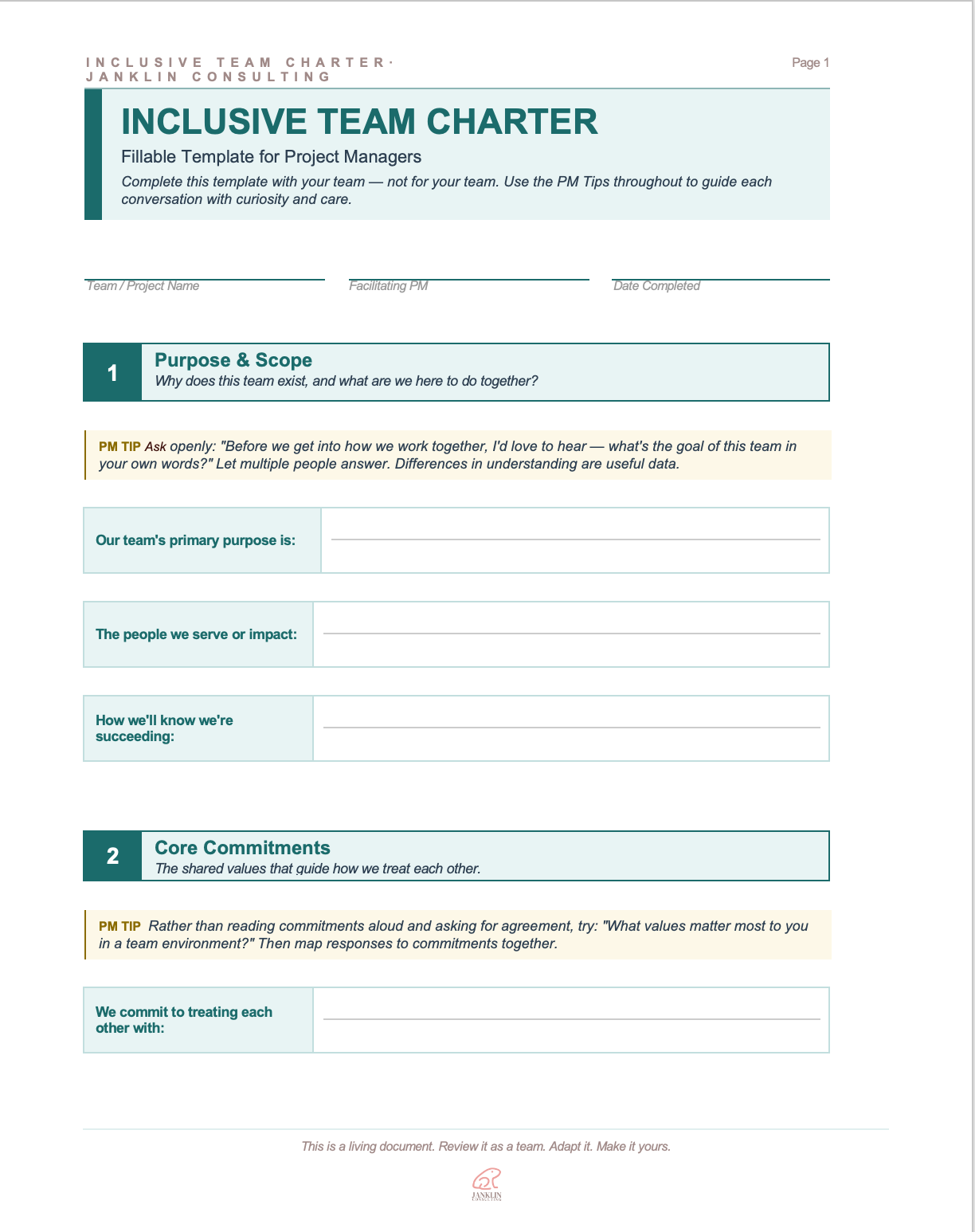
Inclusive Team Charter
From questions about holidays to how to mediate conflict, this inclusive team charter provides questions and spaces to ask meaningful questions for your team. Culture, neurodiversity and trauma are integrated into the template. As human beings, this is essential to our well-being and our workplaces.
You can download this WORD document for free!
Think of this document as a living commitment throughout the team and project lifecycle. Revisit it. Edit it. Expand it. Inviting your team into the process not only allows for their voices to be heard, but for their perspectives to matter.
Inclusive Conversation Cards™
Don’t wait for the conflict to happen.
Have the conversation today.
These playing style cards are a great way to understand the cultural expectations that not only you as a leader bring into a room, but your team as well.
They are designed to understand and create awareness of how to create a more inclusive work environment for:
Neurodiverse People
Persons With Different Cultural and Ethnic Backgrounds
Racialized Staff and Co-Workers
Included are two different types of cards:
Inclusive Conversation Cards - The first prompt is for leaders. The second is for those in the room. And the third is an opportunity to go deeper.
Inclusive Ice Breaker Cards - A lighter, high level conversation starter to get the group talking and sharing.
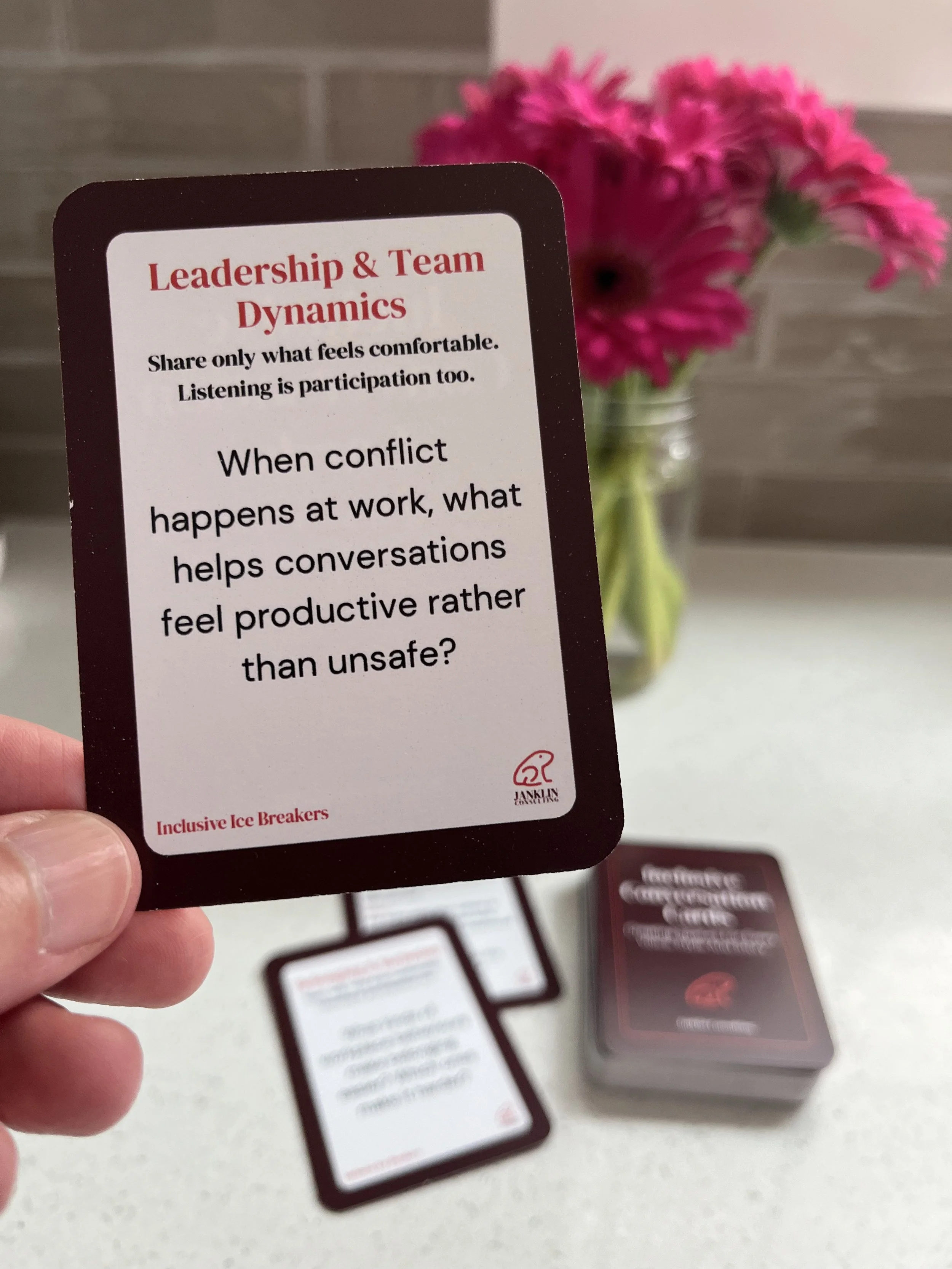
Cards cost $25 + shipping. To purchase, click the button below to complete the shipping form.
A portion of your purchase will be donated to Indigenous Perspectives Society, an Indigenous owned organization providing training in reconciliation efforts, cultural perspectives and Indigenous history.
Canadian Salad Podcast
Join me and my friend Hostion, co-hosts of the podcast Canadian Salad, for a stories from immigrants, refugees and racialized individuals who often have to bear the weight of belonging and inclusion. From borders that exclude, to questions that separate, explore conversations where belonging is more than desire - it’s an essential piece of making a more safe society for everyone.
The Educators
Representing voices who know what belonging is and listening to their perspectives is key. Below are a list of online links, book recommendations and other academic materials in case you really want to nerd out on it.
-
The importance of diversity, equity, and inclusion in the workplace cannot be understated. But when half-baked and under-developed strategies are implemented, they often do more harm than good, leading the very constituents they aim to support to dismiss DEI entirely.
DEI Deconstructed analyzes how current methods and “best practices” leave marginalized people feeling frustrated and unconvinced of their leaders’ sincerity, and offers a roadmap that bridges the neatness of theory with the messiness of practice.
A great book I use for trainings and unlearning my own biases when it comes to equity, inclusion and diversity. -
Did you know that most AI models are written and influenced by white tech bros? We know bias exists in our Google searches, our media and even our language. Justice AI is a wonderful tool to use when you want to create communiques for your team, for your organization and even for you to learn. A low cost platform with possibilities to integrate into your main chat apps. I highly recommend it.
-
At a time marked by division, polarization, and seemingly innumerable global crises, belonging is the cornerstone for societal well-being and prosperity. This report, Forging a Future of Belonging: Building Awareness and Will for a Canada-Wide Strategy, draws upon the collective insights of hundreds of individuals who have. contributed towards shaping the Tamarack Institute’s call for a Strategy for Belonging. It summarizes the insights, aspirations, and actions shared by communities in 2024 on building belonging and shaping more equitable futures.
-
Written by Signal49 Research (formerly the Conference Board of Canada), this impact paper explores best practices for building and supporting a neurodiverse workforce and allows organizations to consider a strengths-based approach to workforce development.
That was a lot!
I know. Your brain probably hurts after reading all this juicy stuff about inclusion and belonging. Before you leave:
1. Take this information with you!
I’ve created a downloadable, free, printable PDF you can file away in your resource library or share with a colleague.
2. An invitation to explore more!
Bring this into your team — I run half-day workshops on belonging and inclusion for developing a stronger relational leadership. Together we can make the friction less painful. Let's talk.